Sale!

Diploma in Cat Behaviour

From: R2 525,00 / month for 30 months

Clear

SKU: N/A Category: Tag:

Description

This course is perfect for individuals looking to further their understanding in the field of Cat Behaviour, to assess emotional and behavioural well-being and learn how to implement successful behaviour modification programs.

Successful completion will enable you to achieve your goal of making Cat Behaviour your full-time profession, whether you choose to work with pet cats, cats in rescue facilities, those who require rehabilitation or in fact any cat where behavioural analysis, emotionality and behaviour modification may be required.

Being your own boss has a lot of merit for people who enjoy working from home and working their own hours. If you choose to work with companion animals, networking with rescue organisations and veterinarians in your area is very important as this is where the majority of your referrals will come from. Most of these establishments do not have the time or resources available to address behaviour problems and are usually very relieved to be able to refer clients with problematic pets to someone who is highly qualified to deal with them. Plus, COAPE keeps a database of students who have successfully completed the Diploma and refers clients to them regularly.

Students who successfully complete the Diploma in Cat Behaviour will hold the qualification of ‘COAPE Qualified Behaviour Practitioner’ and are entitled to use the post nominals (DipCABT-C) C.C.A.B after their name. Only COAPE qualified behaviourists can become members of the prestigious CABTi and have automatic membership to the International Companion Animal Network (ICAN)

This is a demanding course comprising approximately 80 hours of pre-recorded lectures, 5 assignments and 3 case studies, with a module of approximately 10 hours of lectures, being presented about every 4 months. In addition, students are required to log pro bono hours.

This course requires dedication as it is one of the highest qualifications of its kind, it is ESSENTIAL that all the books are read, and that additional independent research is done to ensure good marks.

Course Options:

  1. Standard 24-month course: Modules released on set dates with corresponding assignment deadlines. This option allows you to progress through your course with the support of your fellow students.
  2. Do It In Your Own Time (DIIYOT): Has no pre-set assignment dates, a new module is released when your assignment for the previous one is received. The maximum time allowed for completion is 36 months.

This diploma starts every April and October (enrolments close 2 weeks prior).

DIIYOT students may begin at any time.

Certificates are awarded upon successful completion.

 

Learning Outcomes

  • How to assess a cat’s mood state and emotionality, be able to identify if their environment allows the cat to engage in species specific behaviours.

  • Be able to compile a Behaviour Modification report for the client and assist them in working through it, to minimise or eradicate the problematic behaviour.

  • The student will be taught how to conduct a consultation and how to write both client and vet reports.

Requirements

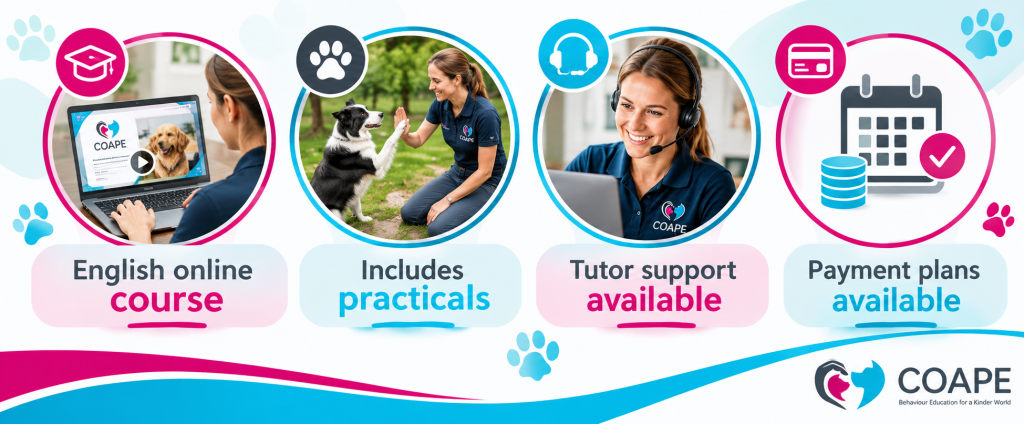
  • This course is an online, English course and requires you to be computer literate and have a stable internet connection

  • To successfully do this course you must have access to Microsoft Word

  • Please note that your course notes are included in the course fee, however any prescribed books need to be purchased and paid for on top of this.

Unit Descriptions

Module 1

  • Domestication process in cats.
  • Feline Senses – designed as a hunter.
  • The physical and emotional behaviour of survival in cats.
  • The physical and emotional development on the modern-day pet cat.

Module 2

  • Basic Neurophysiology – the brain, neurotransmitters, hormones.
  • Learning Theory relating to cats.
  • Ethics of punishment.
  • Use of signals of reward and non-reward.
  • Feline Communication – verbal and non-verbal.
  • Dietary influence on behaviour.
  • Managing resources in a multi-cat household.

Module 3

  • Core Emotional states – Panksepp’s seven systems plus the Self-Care system.
  • Behavioural Inhibition system.
  • Problem assessment and application using HBA protocols.
  • Therapeutic application of the emotional systems: ESTA.
  • Neuroscience of the Core Emotional systems.
  • Consent and control in training and behaviour.
  • Creating a cat friendly home and garden.
  • Indoor vs outdoor cats.

Module 4

  • Psychopathology in humans and animals.
  • Predatory behaviour in cats.
  • Reproductive behaviour.
  • Neutering/spaying.

Module 5

  • Aggressive and reactive behaviour.
  • Marking behaviour in cats.
  • Behavioural Pharmacology
  • Protocols for common feline behaviours:
    – Cat to cat introductions.
    – Cat to dog introductions.
    – Introducing how to use a Cat Flap.
    – Teaching bite and claw inhibition.

Module 6 and Case Study 1

  • Counselling skills.
  • Case study discussions.
  • Pre-prepared Case Study.

Case Studies 2 and 3

2 Case studies to be undertaken with guidance from your Tutors.

Teachers

George van Huyssteen

George van Huyssteen

Leigh Shenker

Leigh Shenker

Aungenie Cuthbert

Aungenie Cuthbert

Marion Leiberich

Marion Leiberich

Additional information

Course type

Standard Course, Do It In Your Own Time (DIIYOT)

Payment options

Pay full fee upfront (5% discount), Deposit plus remaining amount in 30 days (2.5% discount), Deposit plus monthly payments (Incl. 10% compound interest), NO deposit, just monthly payments (Incl. 10% compound interest)

Reviews

There are no reviews yet.

Be the first to review “Diploma in Cat Behaviour”

Your email address will not be published. Required fields are marked *