For decades, the Five Freedoms have shaped the way organisations, shelters, trainers, and policymakers understood and evaluated animal welfare. They were groundbreaking in their time—providing a simple, accessible framework for identifying suffering and preventing harm. However, as behavioural science and welfare research have advanced, it has become clear that the Five Freedoms, while foundational, no longer capture the full picture of what animals need to thrive.
First introduced in the 1960s and formalised in 1979, the Five Freedoms were designed to ensure that animals would have:
These freedoms remain deeply important. They help identify what must be avoided to protect animals from poor welfare. However:
The Five Freedoms set an essential minimum standard—but minimum standards are not enough for modern welfare practice.
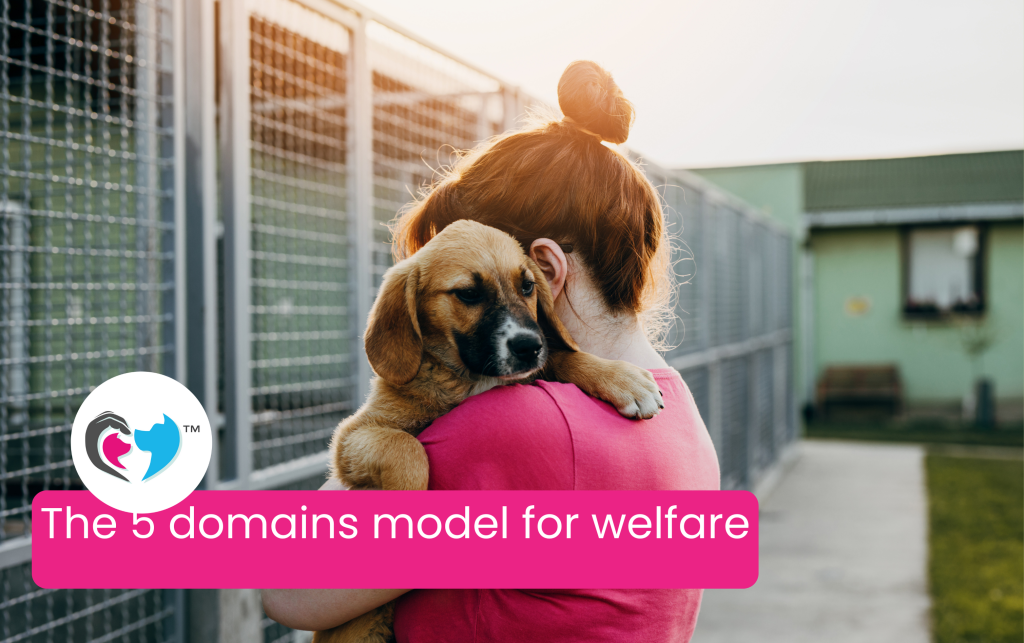
Enter the Five Domains Model—a modern, science-driven framework that moves the welfare conversation beyond simply preventing suffering and towards actively promoting positive experiences. For professionals committed to evidence-based welfare, especially those studying with COAPE, the Five Domains are now considered the gold standard.
Developed by Professor David Mellor and colleagues, the Five Domains Model extends far beyond avoiding harm. It recognises that welfare is shaped by a complex interaction between physical and psychological factors.
The model consists of:
The key innovation lies in Domain 5: the Mental State, which is influenced by the first four domains. It acknowledges that animals are sentient beings capable of a wide spectrum of emotional experiences—positive and negative.
Why the Five Domains Model is Superior for Modern Animal Welfare:
1. It recognises positive welfare, not only the absence of suffering.
Where the Five Freedoms aim to prevent negative experiences, the Five Domains framework asks a deeper question:
What positive experiences can we provide?
This includes opportunities for:
Promoting positive emotions is now a central goal of global welfare science.
2. It aligns with contemporary research on behaviour and neuroscience.
Modern studies consistently highlight the importance of mental wellbeing, emotional resilience, and cognitive stimulation in animals. The Five Domains explicitly incorporate this research by making mental state an evaluated domain—not an implied one.
For organisations like COAPE, which train behaviour professionals using current science, this model better reflects what we now know about animal emotion, learning, and stress.
3. It provides a practical tool for welfare assessment
The Five Freedoms are conceptually helpful but difficult to apply systematically.
The Five Domains offer:
This makes it ideal for evidence-based welfare management.
4. It integrates behavioural opportunities into welfare planning
Domain 4 (Behavioural Interactions) encourages caretakers to provide animals with the ability to engage in meaningful, species-appropriate behaviours such as:
Rather than simply allowing “normal behaviour,” the Five Domains emphasise the quality and richness of behavioural opportunities.
5. It moves animal welfare culture toward proactive care
The Five Freedoms are reactive (“stop bad things from happening”).
The Five Domains are proactive (“create good things”).
For shelters, behaviour professionals, veterinary teams, and pet owners, that shift changes everything—from the way environments are designed to the kinds of interactions animals experience daily.
The Five Freedoms laid the groundwork for global animal welfare—an achievement that should never be understated. But animal welfare science has evolved, and our frameworks must evolve with it.
The Five Domains Model provides a richer, more accurate, and more humane understanding of what animals need to thrive emotionally and physically. It moves us from a culture of avoiding harm to a culture of promoting wellbeing.
For modern welfare practitioners—and for COAPE students shaping the future of welfare—the Five Domains are not just an improvement; they are essential.